


 Cart
Cart
 sales@molnova.com



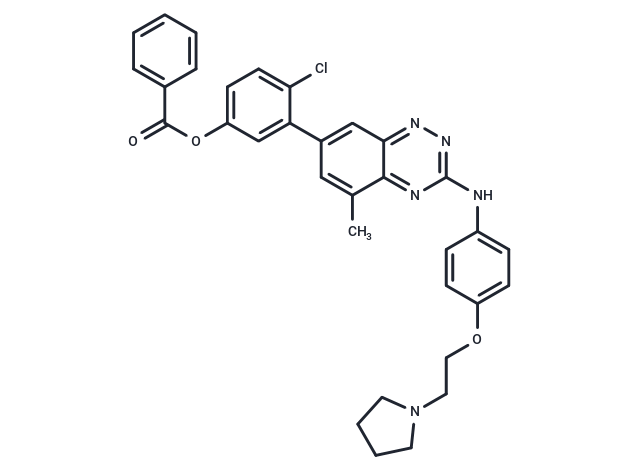
TG 100801
CAS No. 867331-82-6
TG 100801( —— )
Catalog No. M33149 CAS No. 867331-82-6
TG 100801 is a dual inhibitor of VEGFr2 and Src family (Src and YES) kinases and is a candidate compound for the treatment of age-related macular degeneration (AMD).
Purity : >98% (HPLC)
 COA
Datasheet
HNMR
HPLC
MSDS
Handing Instructions
COA
Datasheet
HNMR
HPLC
MSDS
Handing Instructions
| Size | Price / USD | Stock | Quantity |
| 2MG | 128 | Get Quote |


|
| 5MG | 188 | Get Quote |
|
| 10MG | 277 | Get Quote |
|
| 25MG | 453 | Get Quote |
|
| 50MG | 660 | Get Quote |
|
| 100MG | 888 | Get Quote |
|
| 500MG | 1782 | Get Quote |
|
| 1G | Get Quote | Get Quote |
|
Biological Information
-
Product NameTG 100801
-
NoteResearch use only, not for human use.
-
Brief DescriptionTG 100801 is a dual inhibitor of VEGFr2 and Src family (Src and YES) kinases and is a candidate compound for the treatment of age-related macular degeneration (AMD).
-
DescriptionTG 100801 is a proagent that generates TG 100572 by de-esterification in development to treat age-related macular degeneration. TG 100572 is a multi-targeted kinase inhibitor which inhibits receptor tyrosine kinases and Src kinases; has IC50s of 2, 7, 2, 16, 13, 5, 0.5, 6, 0.1, 0.4, 1, 0.2 for VEGFR1, VEGFR2, FGFR1, FGFR2, PDGFRβ, Fgr, Fyn, Hck, Lck, Lyn, Src, Yes, respectively.
-
In VitroTG 100801 is a topically administered prodrug delivered as an eye drop that is readily converted to the active TG 100572 in the eye.TG 100572 is shown to inhibit hRMVEC cell proliferation, with an IC50 of 610±72 nM. TG 100801 is formed by derivitization of a phenolic moiety in TG100572 to yield an ester. It displays excellent balance of stability (physical and chemical) with hydrolysis rate. On its own, TG 100801 does not display meaningful anti-kinase activity, as the ester group blocks key interactions with kinase active sites, however exposure to esterases (abundant in mammalian tissues) rapidly liberates active TG100572.TG 100572 shows sub-nanomolar activity against the Src family as well as RTK such as VEGFR1 and R2, FGFR1 and R2, and PDGFRβ. TG 100572 inhibits vascular endothelial cell proliferation (ED50=610±71 nM) and blocks VEGF-induced phosphorylation of extracellular signal-regulated kinase. TG 100572 induces apoptosis in rapidly proliferating, but not quiescent, endothelial cell cultures.
-
In VivoTG 100801 exhibits excellent ocular pharmacokinetics and poor systemic circulation and shows good efficacy in the laser induced choroidal neovascularization model. A concentration of 23.4 μM (Cmax) of TG 100572 is reached in 30 min (Tmax)=0.5 h) in the choroid and the sclera. However, the levels of TG 100572 in the retina are relatively low. The half-life of TG 100572 in ocular tissues is very short; hence, the compound is administered topically minimum t.i.d. to maintain appropriate drug levels in the eye. The maximum concentration one can achieve in formulations using TG 100572 is 0.7% w/v. TG 100801 nor TG100572 are detectable in plasma following topical delivery of TG 100801, and adverse safety signals (such as weight loss) are not observed even with prolonged dosing schedules. Topical TG 100801 significantly suppresses laser-induced choroidal neovascularlization in mice, and reduces fluorescein leakage from the vasculature and retinal thickening measured by optical coherence tomography in a rat model or retinal vein occlusion.Systemic delivery of TG 100572 in a murine model of laser-induced choroidal neovascularization (CNV) causes significant suppression of CNV, but with an associated weight loss suggestive of systemic toxicity.
-
Synonyms——
-
PathwayAngiogenesis
-
TargetVEGFR
-
RecptorVEGFR | Src
-
Research Area——
-
Indication——
Chemical Information
-
CAS Number867331-82-6
-
Formula Weight580.08
-
Molecular FormulaC33H30ClN5O3
-
Purity>98% (HPLC)
-
SolubilityIn Vitro:?DMSO : 5.56 mg/mL (9.58 mM; Ultrasonic )
-
SMILESCc1cc(cc2nnc(Nc3ccc(OCCN4CCCC4)cc3)nc12)-c1cc(OC(=O)c2ccccc2)ccc1Cl
-
Chemical Name——
Shipping & Storage Information
-
Storage(-20℃)
-
ShippingWith Ice Pack
-
Stability≥ 2 years
Reference
1. Palanki MS, et al. Development of prodrug 4-chloro-3-(5-methyl-3-{[4-(2-pyrrolidin-1-ylethoxy)phenyl]amino}-1,2,4-benzotriazin-7-yl)phenyl benzoate (TG100801): a topically administered therapeutic candidate in clinical trials for the treatment of age-related macular degeneration. J Med Chem. 2008 Mar 27;51(6):1546-59.?
molnova catalog



related products
-
FTI 277 hydrochlorid...
FTI 277 hydrochloride is an effective and specific farnesyltransferase (FTase) inhibitor (IC50: 500 pM); this selectivity is about 100-fold than the closely related GGTase I.
-
Semaxanib
Semaxanib (SU5416) is a potent and selective VEGFR(Flk-1/KDR) inhibitor with IC50 of 1.23 μM.
-
AKB-6899
AKB-6899 is an inhibitor of prolyl hydroxylase domain 3 (PHD3) and increases the soluble form of the VEGF receptor (sVEGFR-1) production from GM-CSF-treated macrophages.
